The International Society for Infectious Diseases (ISID) and ISID-Africa convened a virtual webinar on 29 September 2026 to explore the growing role of Wastewater and Environmental Surveillance (WES) in strengthening antimicrobial resistance (AMR) surveillance and public health action. The webinar brought together experts from Pakistan, South Africa, and Singapore to examine how wastewater surveillance, genomics and epidemiological intelligence can complement conventional AMR surveillance and support a more integrated One Health response.
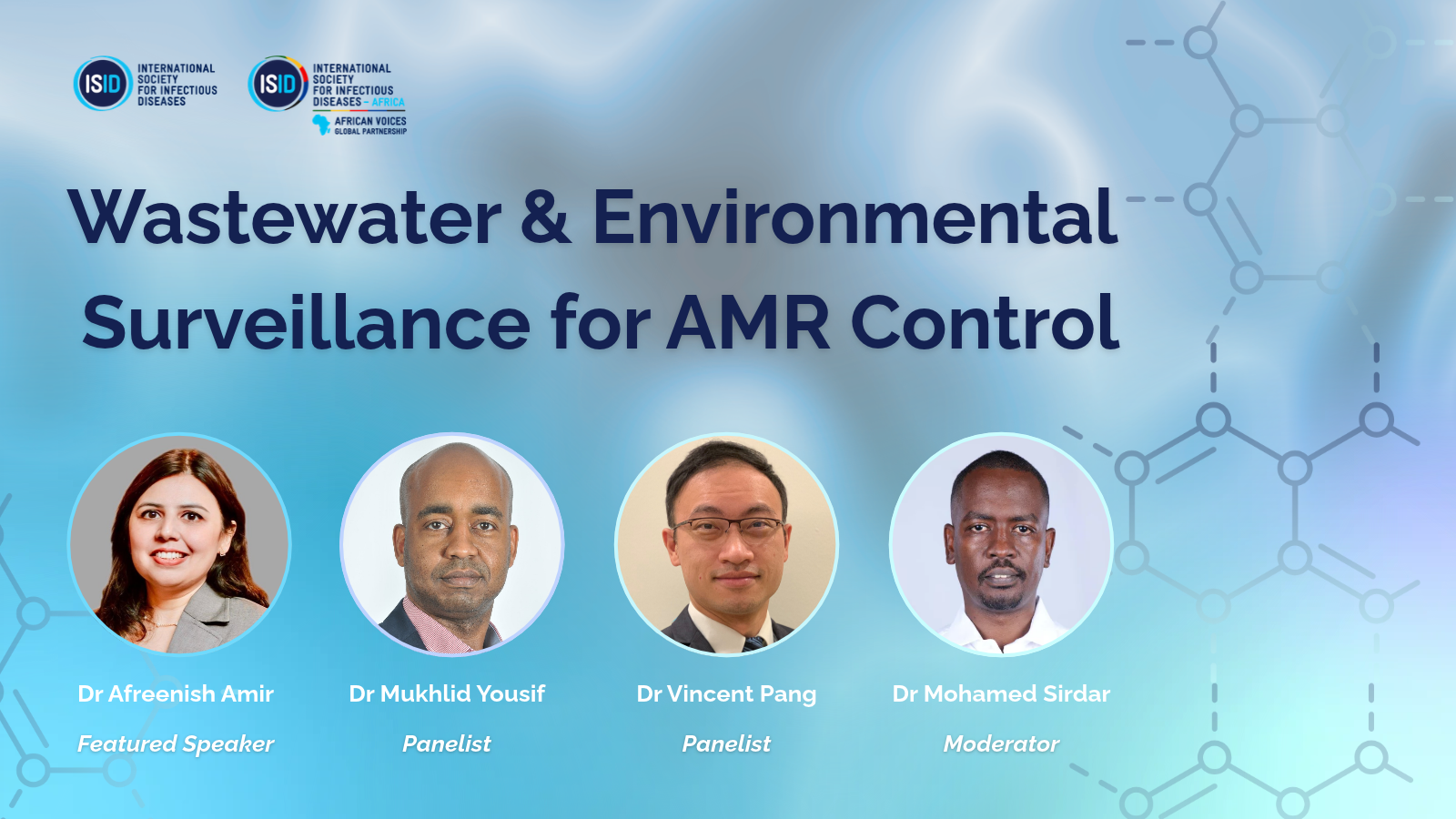
The session was moderated by Dr Mohamed M. Sirdar, Interim Director of ISID-Africa and ISID Global Program Specialist for AMR, and featured Dr Afreenish Hassan Amir, Dr Mukhlid Yousif and Dr Vincent Pang. The discussion connected experiences across Asia and Africa and focused particularly on moving WES beyond research and detection towards sustainable surveillance systems capable of informing public health decisions.
Wastewater Surveillance as an Early Warning System
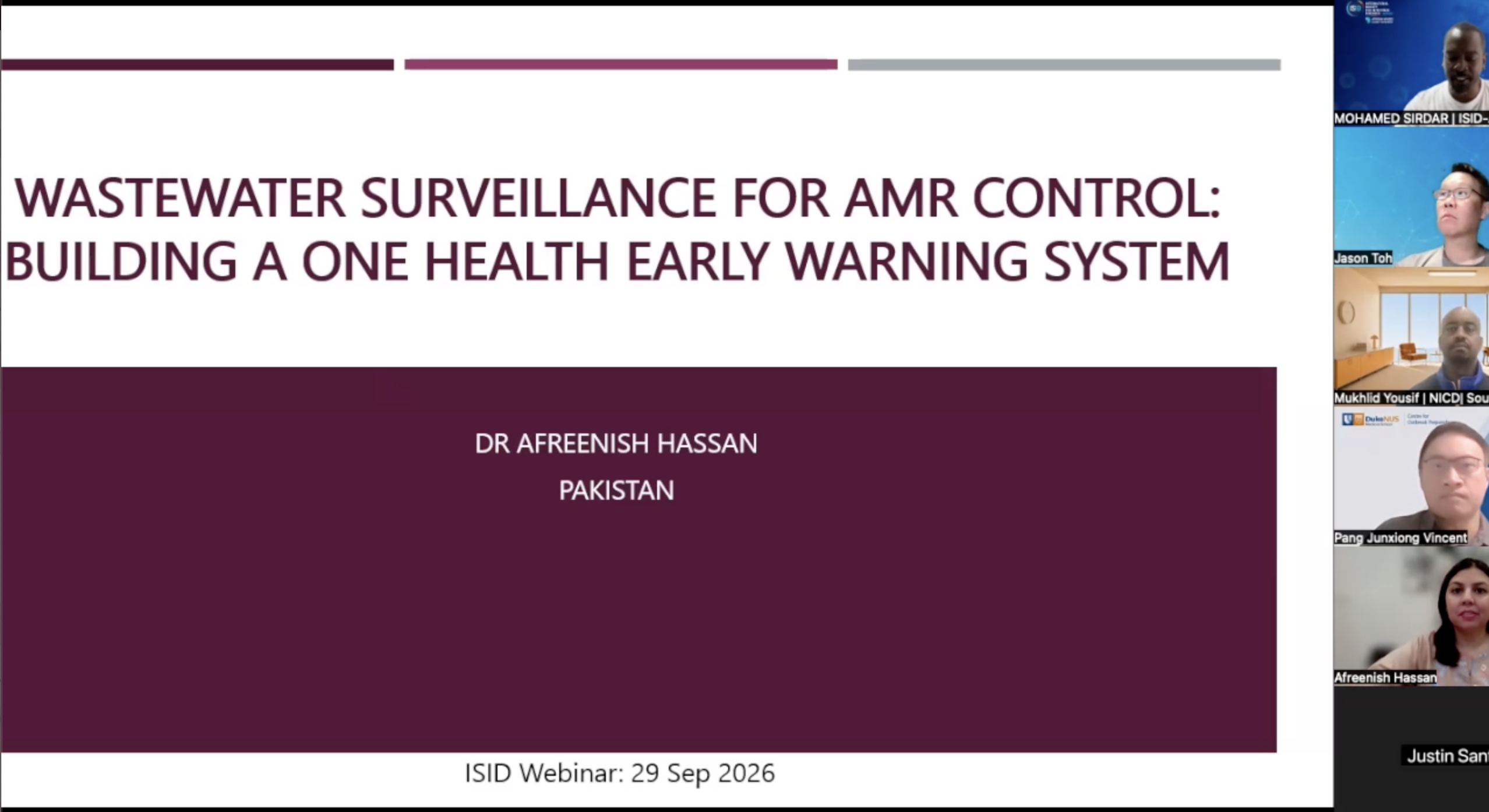
Dr Afreenish Hassan Amir opened the scientific programme with a presentation titled "Wastewater Surveillance for AMR Control: Building a One Health Early Warning System." She highlighted a fundamental limitation of conventional AMR surveillance: its predominant dependence on clinical and healthcare-based data, which can leave important gaps in understanding resistance circulating at population and environmental levels.
Wastewater surveillance provides a complementary lens. By sampling wastewater from communities, healthcare facilities and other settings, surveillance programmes can detect resistant organisms, antimicrobial resistance genes, specific clones and broader trends without depending solely on individual clinical testing. This provides opportunities to identify emerging signals and better understand the circulation of AMR across populations. Drawing on published evidence and international experience, Dr Amir illustrated how WES is already being applied at different scales. Evidence presented from Greater Sydney demonstrated the detection of ESBL-producing Escherichia coli, carbapenem-resistant Enterobacterales, vancomycin-resistant enterococci and methicillin-resistant Staphylococcus aureus in untreated wastewater, while also showing that resistance patterns may be associated with different epidemiological and healthcare drivers.
The presentation also highlighted a national wastewater surveillance study in the United States covering 163 wastewater treatment plants across 40 states. The example demonstrated the potential for wastewater surveillance to quantify antibiotic resistance genes at scale while revealing geographical variation and associations with factors such as antibiotic use, healthcare, animal agriculture and environmental conditions.
Hospital wastewater was discussed as another potentially valuable surveillance setting. Monitoring wastewater from healthcare facilities could support identification of AMR hotspots, monitoring of resistance trends, evaluation of interventions and potentially provide early signals of emerging resistance. At the same time, the presentation emphasised the importance of interpreting wastewater findings alongside clinical, epidemiological and genomic information rather than treating WES as a stand-alone surveillance system.
Integrating Wastewater Surveillance Into Public Health Systems
The webinar subsequently moved from the technical potential of wastewater surveillance to the more difficult question of how surveillance information can be translated into action.
The expert panel explored how WES could be incorporated into existing national AMR surveillance architectures rather than developed as a parallel system. Discussions considered the need to connect environmental findings with clinical and laboratory surveillance, epidemiological information and national AMR programmes.
Dr Mukhlid Yousif, Senior Genomics and Public Health Scientist and Co-Director of the Wastewater Genomics Syndicate at South Africa's National Institute for Communicable Diseases (NICD), contributed perspectives from South Africa and the African region. His work focuses on translating genomic and molecular information into actionable public health intelligence and has included contributions to national, Africa CDC and WHO-related WES initiatives. Dr Vincent Pang, who leads the Asia Wastewater & Environmental Surveillance Initiative at the Duke-NUS Centre for Outbreak Preparedness, brought a regional Asian and epidemiological perspective to the discussion. His experience spans infectious disease surveillance, risk assessment, outbreak investigation and pandemic preparedness.
The panel considered some of the major implementation questions facing countries seeking to establish or expand WES: what should be monitored, where sampling should occur, which laboratory and genomic technologies are appropriate, how results should be interpreted, and what information is sufficient to trigger a public health response. Sustainability was also central to the discussion, including laboratory capacity, workforce, financing, institutional ownership and multisectoral coordination.
Strengthening Regional Collaboration Across Africa and Asia
The discussion extended beyond individual national programmes to consider opportunities for stronger regional WES networks across Africa and Asia. Potential areas for collaboration included sharing technical expertise, surveillance protocols, sequencing capacity, data platforms and reference laboratory services. Harmonisation emerged as an important consideration. Differences in sampling strategies, laboratory methods, genomic analysis and reporting can make comparison and interpretation across settings difficult. Greater standardisation, while allowing adaptation to national contexts and available resources, could strengthen the contribution of WES to regional and global AMR intelligence. These issues were among the core questions considered by the expert panel.
Moving From Surveillance to Public Health Action
A central message emerging from the webinar was that detecting antimicrobial-resistant organisms or resistance determinants in wastewater is not, by itself, the end point of surveillance. The value of WES ultimately depends on whether the information generated can be interpreted alongside other surveillance data and translated into decisions.
This requires stronger connections between environmental surveillance, clinical and laboratory systems, epidemiology, genomics and the institutions responsible for AMR prevention and response. Sustainable WES therefore depends not only on technology, but also on governance, workforce capacity, financing, data interpretation and mechanisms that connect surveillance signals with action.
The webinar concluded with a forward-looking question to the panel: what single change will be most important over the next five years to move WES from promising surveillance and research projects into sustainable systems that routinely inform public health action?
Through this webinar, ISID and ISID-Africa provided a platform for connecting experiences across regions and disciplines and advancing discussion on how environmental intelligence can strengthen the global response to AMR. The session reinforces ISID's broader commitment to integrated surveillance, epidemic intelligence, antimicrobial resistance and One Health approaches that translate evidence into public health action.