Donate

« All News

ISID-Africa Advances One Health AMR Leadership at the ReAct Africa Annual AMR Conference 2026

ReAct Africa Annual Antimicrobial Resistance (AMR) Conference 2026 (RAAC 2026)

The International Society for Infectious Diseases (ISID)-Africa played an active role in shaping discussions at the ReAct Africa Antimicrobial Resistance (AMR) Conference 2026 (RAAC 2026), one of Africa's leading platforms for advancing coordinated action against antimicrobial resistance. The conference brought together policymakers, researchers, public health leaders, development partners, and civil society under the theme, "Africa Leading the Way to Institutionalizing Pragmatic People-Centred AMR Solutions from Grassroots to Regional Level."

Representing ISID-Africa, Dr Mohamed Sirdar, Interim Director of ISID-Africa and Global Program Specialist (AMR), contributed across multiple high-level activities, including a scientific presentation, an expert panel discussion on AMR surveillance, and an invitation-only strategic consultation convened by GARDP Africa.

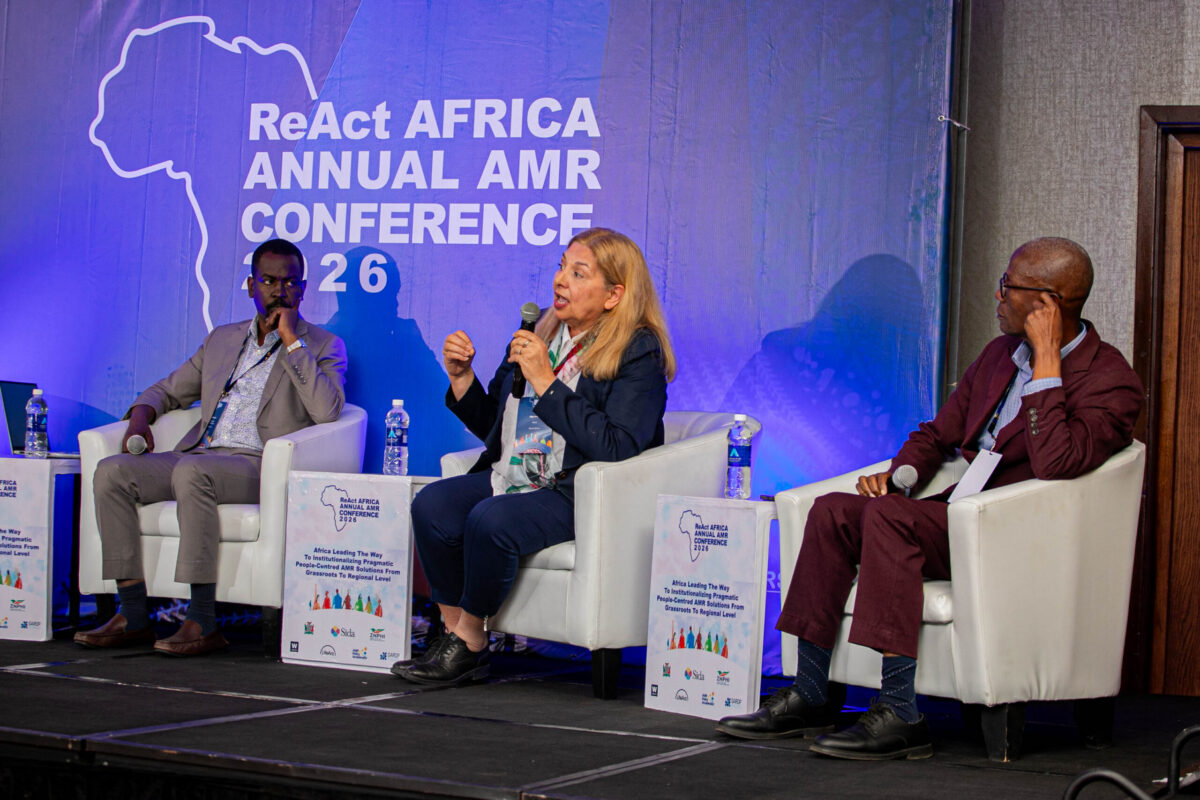
Dr Mohamed Sirdar (ISID-Africa, South Africa), Dr Olga Petrovic (NICD, South Africa), Prof Aaron O. Aboderin (Nigeria)

Advancing One Health Surveillance for Animal Health

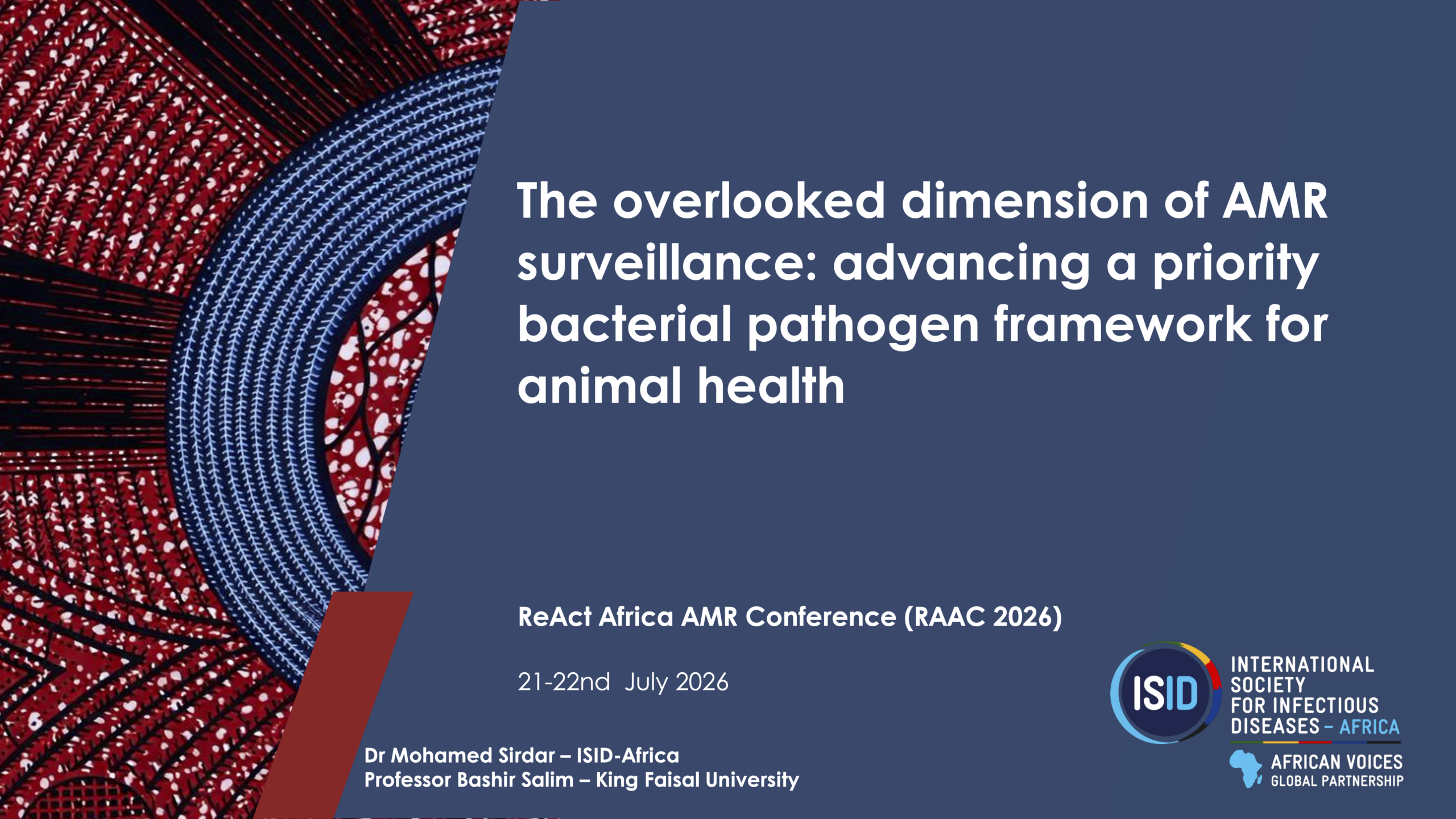
A major highlight of ISID-Africa's participation was Dr Sirdar's presentation entitled, "The Overlooked Dimension of AMR Surveillance: Advancing a Priority Bacterial Pathogen Framework for Animal Health."

Delivered during the conference's parallel session on AMR Surveillance in Human Health and the Environment, the presentation addressed a critical gap in global One Health surveillance; the absence of an internationally harmonized bacterial priority pathogen framework for animal health. The session focused on practical approaches for strengthening surveillance systems, improving laboratory data quality, and translating surveillance evidence into public health action. 

Drawing on a comprehensive review of WHO, WOAH and FAO frameworks together with recent scientific evidence, the presentation proposed the development of a Priority Bacterial Pathogen List for Animal Health (PBPL-AH) to complement the WHO Bacterial Priority Pathogens List for human health. The proposed framework seeks to improve harmonization of surveillance systems across human, animal and environmental sectors, strengthen international comparability of AMR data, and support integrated One Health decision-making. 

Following the presentation, Dr Sirdar joined an expert panel on AMR Surveillance, alongside specialists from the National Institute for Communicable Diseases (NICD), South Africa, and other regional institutions including Nigeria. The discussion examined practical experiences in implementing integrated surveillance systems, improving laboratory data quality, strengthening data standardization, linking microbiology results with clinical decision-making, and scaling successful surveillance models across Africa. 

The panel emphasized that effective surveillance extends beyond data collection and must generate timely, high-quality evidence that directly informs policy, stewardship programmes and public health interventions.

Contributing to GARDP's Future Strategy

In recognition of ISID-Africa's growing contribution to AMR research and policy, Dr Sirdar was invited to participate in the GARDP Africa Strategic Consultation, an invitation-only consultation held alongside the conference.

Convened by GARDP Africa in partnership with ReAct Africa, the consultation brought together selected experts from across the continent to help shape GARDP's next five-year strategy. Discussions focused on ensuring that African priorities are fully reflected in future efforts to accelerate antibiotic research and development while improving equitable access to effective antibiotics across the continent. 

ISID-Africa's participation provided an opportunity to contribute perspectives on strengthening research partnerships, surveillance systems, stewardship, and equitable access within a One Health framework.
Aligning with Africa's AMR Priorities

Throughout the conference, discussions consistently reinforced several strategic priorities for the continent, including:

  • Moving from AMR commitments to measurable implementation; 
  • Embedding AMR within existing health, agriculture and environmental systems; 
  • Strengthening One Health collaboration; 
  • Institutionalizing successful interventions; 
  • Investing in sustainable financing; and 
  • Accelerating regional cooperation and country ownership. 

These priorities strongly align with ISID-Africa's mission to strengthen infectious disease surveillance, antimicrobial stewardship, epidemic intelligence, research capacity, and policy translation across Africa.

Dr Mohamed Sirdar discussing AMR priorities for Africa moving forward.

The Way Forward

ISID-Africa remains committed to supporting African countries in developing stronger, evidence-based One Health systems that improve surveillance, guide antimicrobial stewardship, and translate research into policy and practice. Participation in RAAC 2026 further strengthened ISID-Africa's engagement with regional and global partners working to combat antimicrobial resistance and reinforced the Society's commitment to advancing African-led solutions for one of the world's most pressing public health challenges.

News Feed Archives

Types
Donate

The International Society for Infectious Diseases is a 501 (c) (3) not-for-profit organization. Our EIN # is 22-2473000. All contributions are fully tax-deductible.

Follow Us


©2026 International Society for Infectious Diseases. All Rights Reserved.