Donate

« All News

ISID and Pfizer Strengthen Grantsmanship Capacity for AMR Professionals Across Sub-Saharan Africa

Building Grant Writing Capacity Beyond a Single Call

The International Society for Infectious Diseases (ISID), through ISID-Africa, with support from Pfizer Inc., successfully delivered a two-part Grant Writing Capacity and Grantsmanship Building Program on 30 July and 6 August 2026, equipping antimicrobial resistance (AMR) and antimicrobial stewardship (AMS) professionals across Sub-Saharan Africa with practical skills to transform strong ideas into competitive, fundable, and impact-oriented proposals.

The invite-only virtual program was developed for applicants to the 2025 Pfizer/ISID Antimicrobial Stewardship Grand Challenge for Sub-Saharan Africa and represented an important continuation of the capacity-building partnership between ISID and Pfizer.

The 2025 Pfizer/ISID Grand Challenge attracted 407 proposals from 28 countries across Sub-Saharan Africa, demonstrating substantial regional interest in advancing solutions to AMR and AMS. The review process, however, also highlighted an important lesson: many applications contained strong scientific ideas and locally relevant projects but could be strengthened through clearer proposal structure, closer alignment with the Request for Proposals (RFP), more convincing implementation pathways, clearer articulation of expected impact, and stronger monitoring, evaluation and sustainability plans.

This experience became a foundation for the training program. As highlighted in the sessions and training materials, successful proposals were not necessarily distinguished simply by better ideas, but by how clearly and strategically those ideas were communicated and how effectively they responded to what the funder was seeking.

The program was facilitated by Professor Renier Coetzee, Associate Professor in the School of Public Health and NRF SARChI in Health Systems Governance at the University of the Western Cape in South Africa. He also serves as President of the Pharmaceutical Society of South Africa and holds leadership roles with Touching Nations and The AMR Narrative.

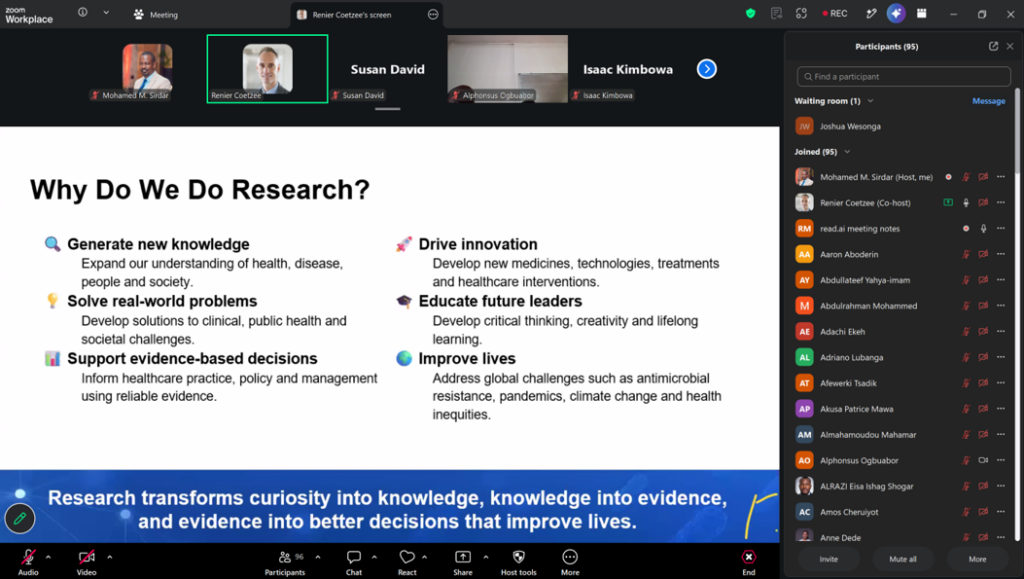
Across the two six-hour sessions, the training moved beyond the mechanics of writing to explore the strategic thinking behind successful grantsmanship. Participants were equipped to interpret donor requirements and RFPs, develop structured and evidence-informed proposals, construct appropriate budgets, apply monitoring, evaluation, and learning (MEL) frameworks, and use standardized tools for future proposal development.

A central theme throughout the program was simple but important: great ideas alone are not enough. Funders need confidence that applicants understand the problem, have evidence to support the need, have assembled an appropriate team, can implement realistic methods within a feasible timeline and budget, and can demonstrate meaningful impact. challenges.
Session 1: From a Good Idea to a Fundable Problem

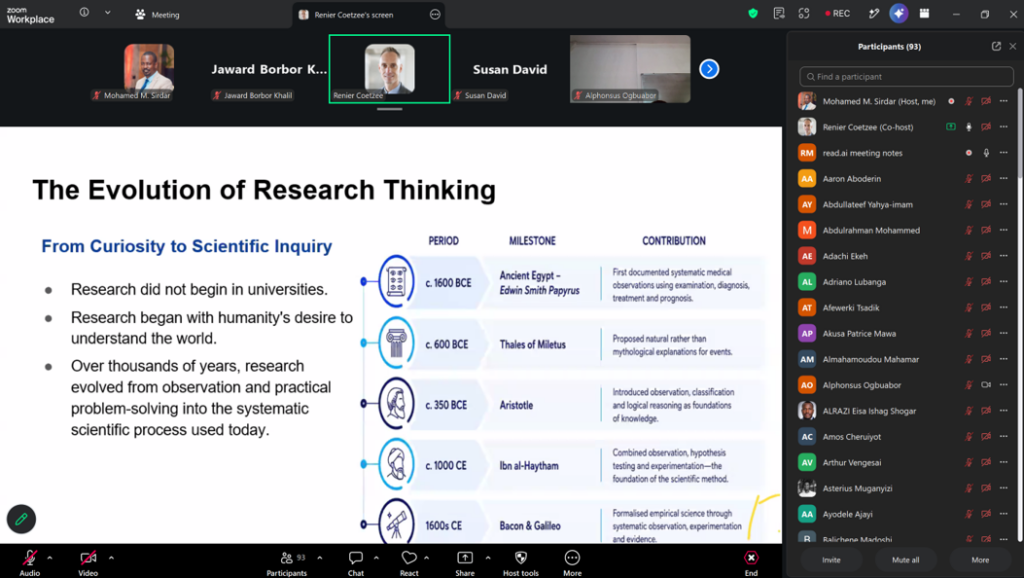
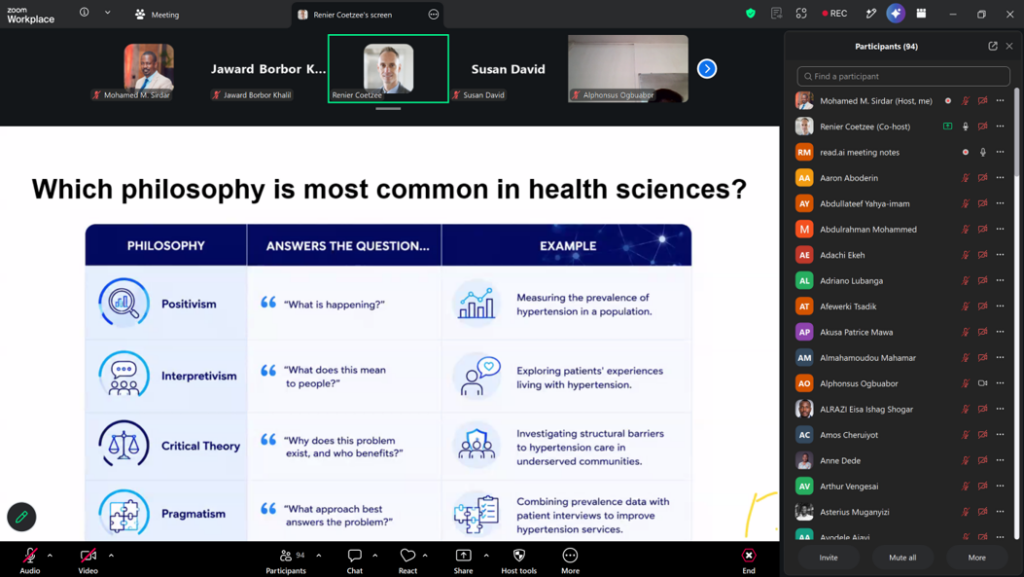
The first session, held on 30 July 2026, laid the foundation for effective grantsmanship. Rather than beginning with the question, "What research do I want to do?", participants were encouraged to approach proposal development from the perspective of the problem that needs to be solved. The training explored what makes a problem fundable: it should be important, evidence-based, relevant, solvable, timely, and aligned with the funder's priorities. From there, participants explored how to move from identifying the problem to designing the solution, building the project before writing the proposal. The training emphasized that a strong grant writing capacity application is not simply a collection of activities, but a coherent project in which the problem, evidence, objectives, interventions, expected results, budget, and measures of success are logically connected.

This approach was reinforced through practical tools, including a Grant Builder Workbook and project-development framework that enabled participants to progressively work through key components such as defining the problem, gathering evidence, identifying stakeholders, developing objectives and logic models, constructing budgets and timelines, selecting indicators, identifying risks and planning for sustainability.

Session Two: Turning Project Design into a Competitive Proposal

The second session, held on 6 August 2026, moved participants further into the practical development of a complete proposal. Participants worked through the core requirements that need to align within a competitive application: applicant eligibility, alignment with funder priorities, evidence of need, target populations, project design, evaluation, timelines, budgets, sustainability and submission requirements. The training distinguished between a project's vision, goal, and objectives, emphasizing that objectives translate an overall project goal into measurable commitments. Participants were encouraged to specify what will change, who will experience the change, where it will occur, when it will happen, and how that change will be measured.

The session also introduced participants to logic models as both planning and communication tools. By connecting inputs, activities, outputs and outcomes, a logic model can help identify gaps, keep activities aligned with objectives, clarify what needs to be measured, create shared understanding within the project team and demonstrate to funders how the proposed intervention is expected to generate impact.

Project design was subjected to a practical "stress test": Is the intervention logical? Evidence-informed? Context-sensitive? Feasible within the available resources? Measurable? Adaptable when implementation challenges arise? This reinforced the importance of developing projects that are not only scientifically sound but also realistic and implementable in their intended settings.

A particularly valuable feature of the program was the use of “Project Ubuntu,” a practical AMS case study that followed participants through different stages of proposal development. The hypothetical project focused on improving adherence to national antibiotic treatment guidelines for adults with pneumonia across three district hospitals. Participants worked through potential interventions including baseline prescription reviews, identification of prescribing gaps and barriers, development of guideline-support resources, capacity strengthening, regular prescription audits, structured feedback to healthcare teams and support for local stewardship champions.

Using an AMR-specific example allowed participants to see how individual components of a proposal connect and how a broad concern such as inappropriate antimicrobial use can be translated into a focused, measurable, and implementable project. The case study also demonstrated how an intervention could align with funding priorities by strengthening AMS in healthcare settings, improving rational antibiotic use, addressing gaps in clinical practice, and generating measurable indicators of improvement.

Another important focus of the training was helping participants demonstrate the pathway between what a project does and what it ultimately changes. Participants explored the resources “or inputs” required to implement a project, including project teams, funding, staff time, participating facilities, guidelines and training resources, data systems, partnerships and stakeholder support. This thinking was then connected to activities, outputs, outcomes and longer-term impact through logic models and MEL frameworks. The approach encouraged participants to design measurement into projects from the beginning rather than treating monitoring and evaluation as an addition at the end of proposal development.

Budgeting was similarly positioned as an integral component of project design rather than a separate financial exercise. Participants learned that a credible budget should be aligned, realistic, complete, proportionate, justified, and compliant with funder requirements, while avoiding unexplained costs, unfunded activities, and unrealistic estimates.

The program generated participation of well beyond the initial target of 50 trainees, reflecting strong demand for practical grant writing capacity among professionals working on AMR and AMS across Sub-Saharan Africa. A total of 140 participants attended the first session and 96 in the second, with 64 participants attending both sessions.  

The engagement also reflects a broader reality facing researchers and health professionals across the region: generating high-quality scientific ideas is only one part of the pathway to impact. Researchers and implementers must also be able to communicate those ideas convincingly, demonstrate feasibility and value, and compete effectively for increasingly limited funding.

The initiative transformed lessons from a competitive funding process into a wider capacity-building opportunity. Rather than benefiting only the projects ultimately selected for funding, knowledge generated through reviewing hundreds of applications was used to strengthen the grantsmanship capacity of a broader community of AMR professionals. Participants were also provided with practical tools and standardized approaches that can be adapted for future funding opportunities. The program was intentionally designed to build transferable skills that participants can apply when responding to other national, regional and international funding calls.

The training concluded by bringing the different elements of grantsmanship back together through a final proposal alignment check: Does the proposal directly respond to the RFP? Is the problem supported by evidence? Are the objectives realistic? Do the activities address the identified need? Can results be measured? Are the work plan, partnerships, budget and sustainability strategy credible and, importantly, do all sections tell the same story?

Through the Grant Writing and Grantsmanship Capacity Building Program, ISID and Pfizer have extended the impact of the Grand Challenge beyond individual grants, investing in the people and skills needed to develop the next generation of locally led AMR and AMS initiatives across Sub-Saharan Africa. By strengthening the pathway from problem identification to project design, from evidence to compelling proposals, and ultimately from funding to implementation and impact, the initiative contributes to building sustainable regional capacity to address one of the most pressing global health challenges.

Prof Photo

About the Facilitator

Renier Coetzee

Renier Coetzee is an Associate Professor in the School of Public Health at the University of the Western Cape, working at the intersection of pharmaceutical science and public health. His work is grounded in pharmaceutical public health, with a particular focus on the safe and appropriate use of medicines in low and middle-income settings. A central theme of his research is antimicrobial resistance, where he explores antibiotic utilisation, stewardship, and the broader health system and environmental drivers that shape resistance.

He is currently the National Research Foundation SARCHI interim leader for Health System Strengthening, contributing to research and dialogue aimed at improving equitable, resilient health systems in South Africa and beyond. His work often bridges policy and practice, and he serves on national and provincial structures where he contributes to medicine use policy, public health strategy, and health systems governance.

News Feed Archives

Types
Donate

The International Society for Infectious Diseases is a 501 (c) (3) not-for-profit organization. Our EIN # is 22-2473000. All contributions are fully tax-deductible.

Follow Us


©2026 International Society for Infectious Diseases. All Rights Reserved.