
Donate

« All News

Animal AMR and Human Disease: VacAMR & ISID Webinar Highlights One Health Solutions

Animal AMR and human disease webinar with Professor Sam Kariuki

Animal AMR and Human Disease: Evidence for One Health Action

The NIHR-funded VacAMR Global Health Research Group, in collaboration with the International Society for Infectious Diseases (ISID), continued its webinar series with a session exploring the connection between animal AMR and human disease. The webinar, titled "Linking Animal AMR to Human Disease: Evidence and Strategies to Disrupt Zoonotic AMR Transmission," was held on 22 June 2026. The webinar brought together researchers, clinicians, veterinarians, microbiologists, public health professionals, policymakers, and students from around the world to discuss practical One Health approaches to reducing the emergence and spread of antimicrobial resistance across human, animal, and environmental interfaces.

The webinar featured Professor Sam Kariuki, Africa Continental Lead and Office Director at the Drugs for Neglected Diseases initiative (DNDi), Nairobi, Kenya, and one of Africa's foremost experts in infectious diseases, antimicrobial resistance, and microbial genomics. Drawing on more than two decades of research and public health leadership, Professor Kariuki provided a comprehensive overview of the scientific evidence linking antimicrobial use in animals to resistant infections affecting humans, while emphasizing practical strategies to interrupt these transmission pathways.

Professor Kariuki opened the session by highlighting antimicrobial resistance as one of the greatest threats to global health, food security, and sustainable development. He noted that while antimicrobials remain indispensable for protecting both human and animal health, their inappropriate and excessive use has accelerated the emergence of resistant pathogens that now compromise the effectiveness of essential medicines. He emphasized that AMR is not confined to hospitals or healthcare settings but is driven by interconnected ecological systems where humans, domestic animals, wildlife, food production systems, and the environment continuously interact.

A central focus of the presentation was the growing body of evidence demonstrating that resistant bacteria and antimicrobial resistance genes circulate between animals and humans through multiple pathways. Professor Kariuki discussed the role of livestock, companion animals, wildlife, aquaculture, food products, water sources, and environmental contamination in facilitating the transmission of resistant organisms. Advances in whole genome sequencing and molecular epidemiology have increasingly confirmed that many resistant bacterial strains and resistance genes are shared across these sectors, reinforcing the need for integrated surveillance under a One Health framework.

The webinar further explored the importance of strengthening surveillance systems capable of monitoring antimicrobial use, antimicrobial resistance, and pathogen transmission across both veterinary and human health sectors. Professor Kariuki highlighted how genomic surveillance has transformed our understanding of AMR epidemiology by enabling the identification of transmission networks, emerging resistance mechanisms, and cross-border dissemination of priority pathogens. He emphasized that integrated surveillance provides critical evidence for informing policy, guiding stewardship interventions, and supporting timely public health action.
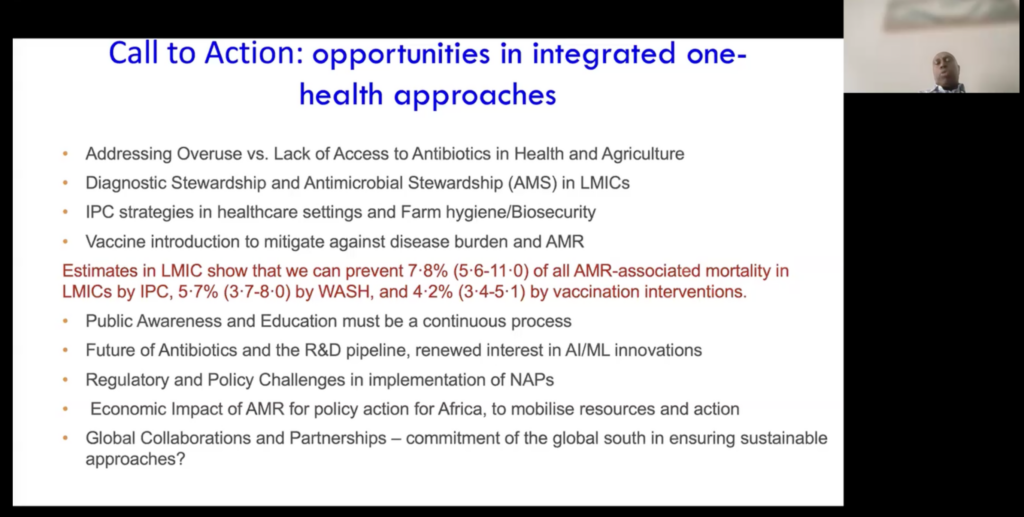

Beyond surveillance, Professor Kariuki emphasized that combating AMR requires a comprehensive prevention strategy rather than relying solely on reducing antibiotic consumption. He discussed how vaccination programmes, improved animal husbandry, enhanced farm biosecurity, strengthened infection prevention and control, improved water, sanitation and hygiene (WASH), responsible antimicrobial stewardship, and better diagnostic capacity collectively reduce disease burden and minimize the need for antimicrobial use. These multimodal interventions not only preserve the effectiveness of existing antimicrobials but also improve animal welfare, food safety, and public health outcomes.

Presentation slide on One Health strategies to reduce animal AMR and human disease through vaccination, stewardship, and biosecurity

The presentation also underscored the importance of policy coherence across sectors. Professor Kariuki called for stronger collaboration between ministries of health, agriculture, environment, academia, research institutions, veterinary services, and international organizations to implement coordinated national One Health AMR strategies. He stressed that investment in prevention, surveillance, research, workforce development, and laboratory capacity is essential for building resilient health systems capable of responding to current and emerging antimicrobial resistance threats.

The webinar concluded with a lively discussion during which participants exchanged experiences on implementing One Health AMR programmes in diverse settings. Questions focused on strengthening surveillance in resource-limited countries, improving antimicrobial stewardship in livestock production, expanding access to vaccines and diagnostics, translating genomic data into policy decisions, and identifying opportunities for greater collaboration between the human and animal health sectors.

The session forms part of the ongoing VacAMR-ISID Webinar Series, which promotes evidence-based approaches to reducing antimicrobial resistance through integrated vaccine and non-vaccine interventions. By bringing together internationally recognized experts from across disciplines, the series continues to strengthen global dialogue on innovative, practical, and sustainable solutions for one of the world's most pressing public health challenges.

ISID extends its sincere appreciation to Professor Sam Kariuki for sharing his expertise and valuable insights, and to all participants whose active engagement enriched the discussion. ISID also acknowledges the continued support of the NIHR-funded VacAMR Global Health Research Group for advancing collaborative efforts to translate scientific evidence into policies and interventions that strengthen antimicrobial stewardship and improve health outcomes across the One Health spectrum.

Sam Kariuki

Sam Kariuki (BVM, MSc, PhD) is the Africa Continental Lead and Office Director for Drugs for Neglected Diseases Initiative (DNDi). He has served as Acting Director General, KEMRI (2021-2023) and Director of Research and Development (2018-2022). He is an African Academy of Sciences fellow, Honorary Faculty at Wellcome Sanger Institute, and visiting/adjunct Professor at Oxford University, the Ohio State University One-Health Initiative, and the University of Nairobi. He is a member of the US National Academy of Medicine and the American Society for Tropical Medicine and Hygiene, the National Antimicrobial Stewardship Interagency Committee (NASIC), and the WHO Strategic Technical Advisory Group on AMR.

Over the last 24 years, his research has focused on the One Health approaches in epidemiology and genomics of AMR and genomic surveillance of key enteric pathogens (Salmonella, Shigella, Cholera, E. coli) endemic in Kenya and the region. His work has led to vaccine clinical trials and improved WASH for the prevention of these diseases. Sam led the development of the National Action Plan to combat AMR.

WATCH THE WEBINAR

News Feed Archives

Types
Donate

The International Society for Infectious Diseases is a 501 (c) (3) not-for-profit organization. Our EIN # is 22-2473000. All contributions are fully tax-deductible.

Follow Us


©2026 International Society for Infectious Diseases. All Rights Reserved.