AMR Surveillance in LMICs: Key Outcomes from ISID WAAW 2025
December 03, 2025
On 24 November 2025, the International Society for Infectious Diseases (ISID) convened a global audience for a World Antimicrobial Resistance Awareness Week (WAAW) webinar focused on “Surveillance Strategies for AMR Control in Low-Resource Settings.” Held under the global theme Act Now: Protect Our Present, Secure Our Future, the session brought together leading experts, practitioners, and partners to address the realities of antimicrobial resistance (AMR) surveillance and explore pathways for improving surveillance capacity across low- and middle-income countries.
The webinar opened with remarks by Dr. Mohamed Sirdar, ISID Global Program Specialist for AMR, who welcomed participants and emphasized the urgency of addressing AMR as a growing global emergency. He highlighted the persistent challenges facing LMICs, including weak diagnostic infrastructure, fragmented reporting systems, and constrained laboratory capacity. Dr. Sirdar stressed that surveillance lies at the heart of health security, enabling governments and health authorities to detect outbreaks early, monitor emerging resistance patterns, and implement timely interventions. He underscored that strengthening surveillance requires not only technical solutions but also global solidarity, cross-sectoral collaboration, and the integration of both traditional and non-traditional data sources.
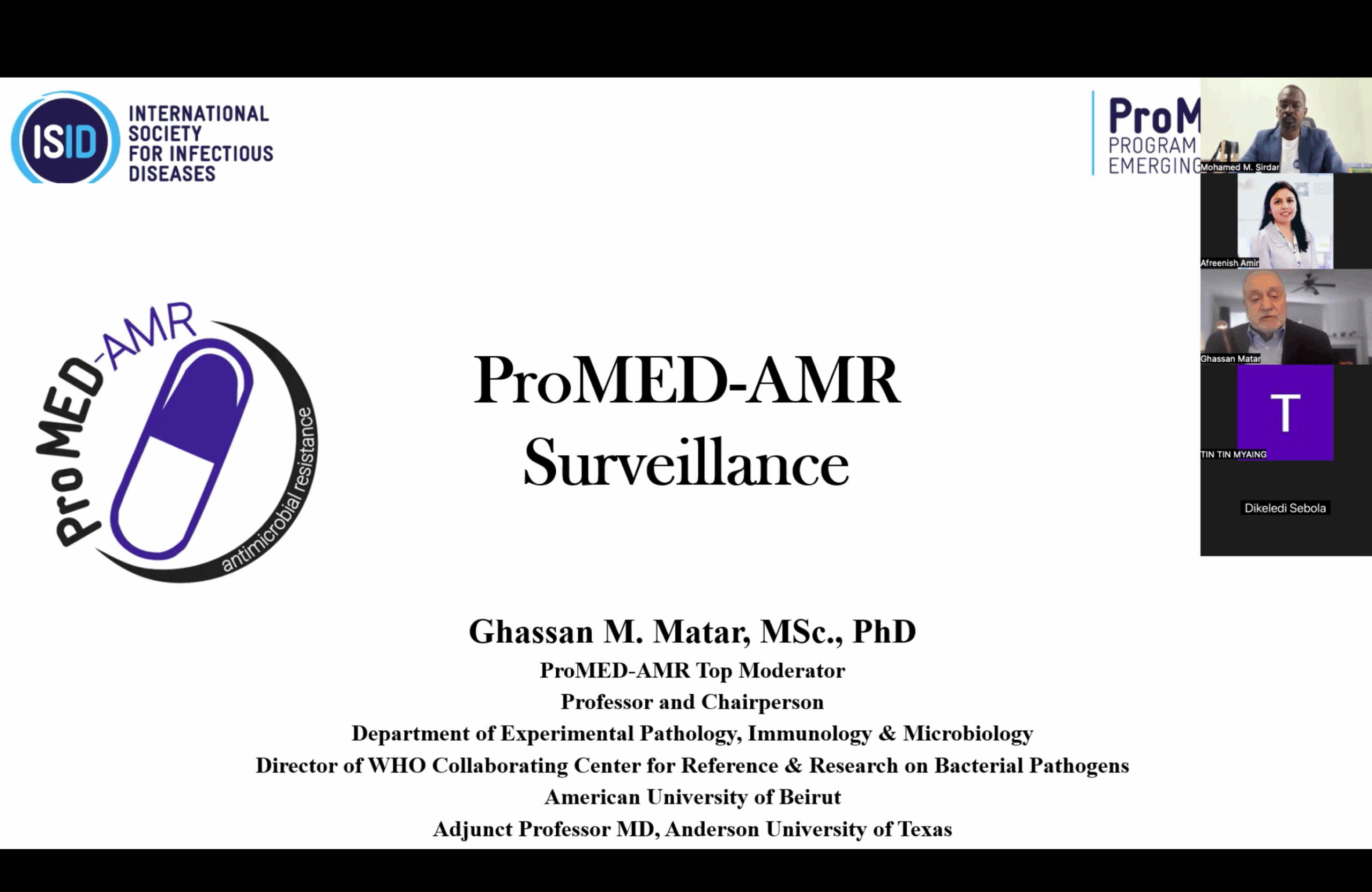
The first presentation of the session was delivered by Professor Ghassan M. Matar, ISID ProMED-AMR Top Moderator and Director of the WHO Collaborating Centre at the American University of Beirut. Prof Matar introduced participants to the functioning and impact of ProMED-AMR, ISID’s global digital surveillance system for antimicrobial resistance. His presentation illustrated how ProMED-AMR uses non-traditional data sources, media reporting, professional networks, community submissions, and field observations to complement formal laboratory-based systems. By incorporating a One Health approach that collects information from human, animal, and environmental sectors, ProMED-AMR enables near real-time detection of unusual resistance patterns, geographic clusters, and emerging hotspots. Professor Matar described the rigorous vetting and commentary process conducted by AMR specialists, ensuring accuracy, context, and immediate dissemination to an international audience. He highlighted the community-driven nature of the system and its value for LMICs, where constrained laboratory systems make early warning mechanisms particularly critical.
The second presentation, delivered by Dr. Afreenish Amir, examined the operational and technical requirements for effective AMR surveillance in LMICs. Drawing on her experience in low-resource settings, she illustrated how rapid shifts in resistance patterns such as the emergence of NDM-5 carbapenem-resistant Salmonella Typhi demonstrate the urgency of building surveillance systems capable of early detection and timely reporting. Dr. Amir emphasized the need to strengthen sentinel laboratory networks supported by robust quality management systems, standardized antimicrobial susceptibility testing (CLSI/EUCAST), reliable specimen referral pathways, and expanded use of digital platforms such as WHONET, DHIS2, and other open-source tools to improve data capture, interoperability, and reporting into national systems and GLASS. She highlighted the importance of integrating human, animal, food, and environmental data within a One Health framework and ensuring that surveillance findings inform antimicrobial stewardship, clinical guidelines, and policy decisions. While acknowledging ongoing challenges such as limited infrastructure, supply chain constraints, and workforce shortages, she underscored that sustainable progress requires strong governance structures, clear national SOPs, dedicated financing mechanisms, and continued capacity development in laboratory, epidemiology, and data analytics competencies.
During the open discussion moderated by Dr. Sirdar, Dr. Tapfumanei Mashe (AMR Project Coordinator, WHO Zimbabwe) contributed an important perspective on African experiences. He highlighted how many African countries face unique barriers related to coordination, data sharing, and sustainable financing for AMR surveillance. Dr. Mashe emphasized that while technical tools exist, countries often struggle with harmonizing data across ministries, ensuring timely reporting into national and global systems, and securing consistent funding for laboratory reagents (although these are partially funded by government), workforce development, and digital infrastructure. His reflections underscored the need for regionally coordinated financing models, standardized data governance agreements, and cross-country learning platforms to support shared progress across the continent.
The broader discussion centred on identifying core priorities for advancing AMR surveillance in LMICs. The webinar reflected on the technical components requiring the most urgent strengthening such as isolate workflows, metadata quality, AST harmonization, and LIMS interoperability and examined strategies for enhancing detection, reporting, and data integration. The importance of linking formal laboratory networks with alternative data sources such as ProMED-AMR, environmental monitoring, and wastewater surveillance was repeatedly highlighted. Discussions also emphasized the long-term sustainability of surveillance systems, drawing attention to the need for strong national policies, stable financing, capable workforce pipelines, and governance structures that can support scalable, multi-sector surveillance ecosystems.
Across the session, it became clear that despite the significant challenges facing LMICs, there is considerable opportunity for innovation. Digital platforms strengthened laboratory networks, One Health integration, and community-driven early warning systems all offer powerful pathways to improve AMR surveillance in resource-limited settings.
The WAAW 2025 webinar reaffirmed ISID’s commitment to supporting global collaboration and capacity strengthening, and to advancing practical, equitable solutions that help countries detect threats earlier, respond more effectively, and ultimately protect populations from the rising tide of antimicrobial resistance.
ISID expresses its appreciation to Professor Ghassan M. Matar, Dr. Afreenish Amir, and all participants for their contributions to a rich, insightful, and action-oriented dialogue.
About the Speakers
Dr. Afreenish Amir
Dr. Afreenish Amir, medical microbiologist, expertise spans AMR surveillance , laboratory systems, antimicrobial stewardship, bacterial/fungal genomic surveillance , waste water environmental surveillance. She has served as Chair of Emerging Leader in Infectious Diseases Program at ISID USA, Federal Region Chapter Head for Pakistan Biological Safety Association. She is Harvard Kennedy School alumna on Global Health Security, GIBACHT fellow on biosafety and biosecurity, served as Consultant with American Society of Microbiology USA and The South Center Geneva, adjunct faculty at Rawalpindi Medical University and Health Services Academy Pakistan. She is member of WHO Advisory Group on BPPL, WHO Global Research Agenda for AMR in Human Health, TAG Fleming Fund UK. She is working GHSA AMR Action Package, Advisory member AMRnet Policy Advisory Group (UK), TWG Asia Pathogen Genomics Initiative (DUKE NUS-Singapore), member Global Typhoid Genomics Consortium (LSHTM UK), CAMONET Pakistan Initiative, and AMR Education in Children, Fleming Initiative.
Professor Ghassan M. Matar ISID ProMED-AMR Top Moderator
Chair of the Department of Experimental Pathology, Immunology and Microbiology [EPIM]
Adjunct Professor, Dept. of Infectious Diseases, UT MD Anderson Cancer Center
Director of WHO Collaborating Centre for Reference and Research on Bacterial Pathogens, American University of Beirut, Lebanon.